Choosing the right tree for your front yard is a long-term investment that defines your home’s curb appeal and environmental footprint. In major American hubs—from the historic streets of New York and Chicago to the sun-drenched suburbs of Los Angeles and Phoenix—the primary challenge is space.
Homeowners need small trees for front yard landscaping that offer the architectural majesty of a full-sized specimen without the risk of invasive roots damaging foundations or branches interfering with overhead utilities.
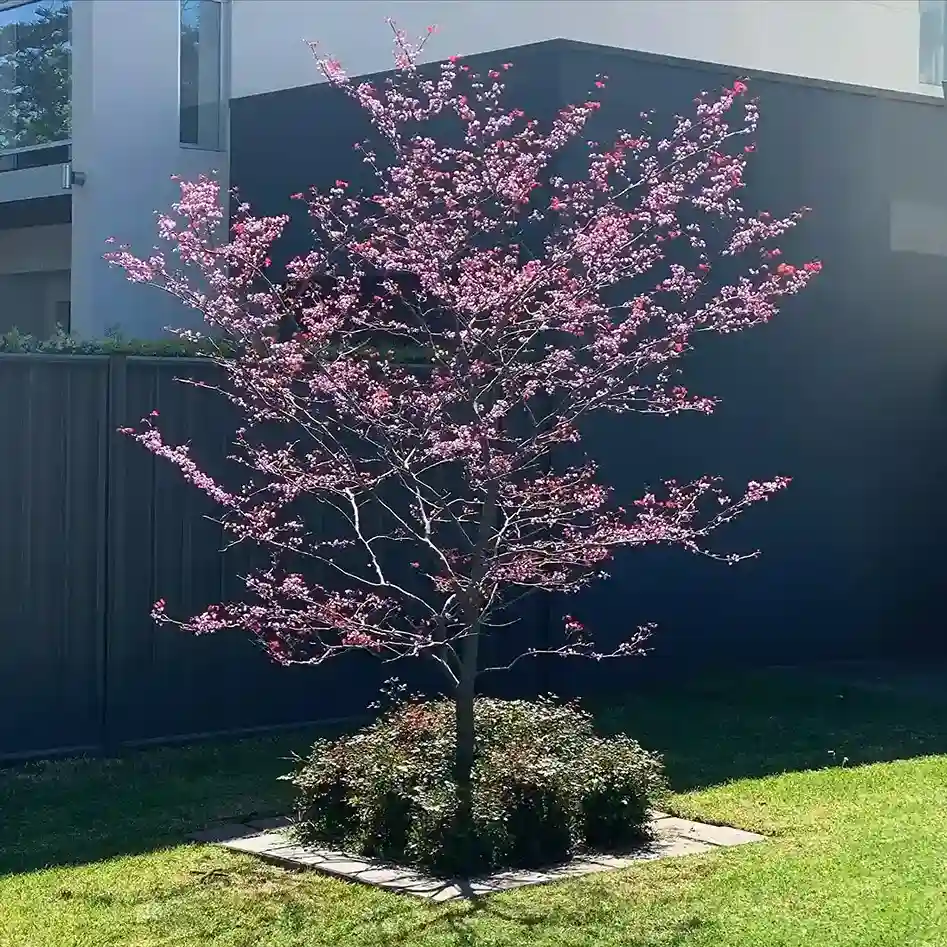
Source: @adelaidetreefarm
This guide provides an exhaustive look at 16 elite small tree varieties tailored for the American landscape. We will explore their botanical characteristics, soil preferences, and how to integrate them into a permaculture garden design that thrives across various hardiness zones.
1. Eastern Redbud (Cercis canadensis)
The Eastern Redbud is the quintessential herald of spring across the United States. It is famous for its “cauliflorous” blooming habit, where tiny, vibrant pinkish-purple flowers erupt directly from the bark of the trunk and branches before the leaves appear. This creates a stunning, neon-like silhouette that provides a high-contrast focal point against a backyard fence or a brick facade.
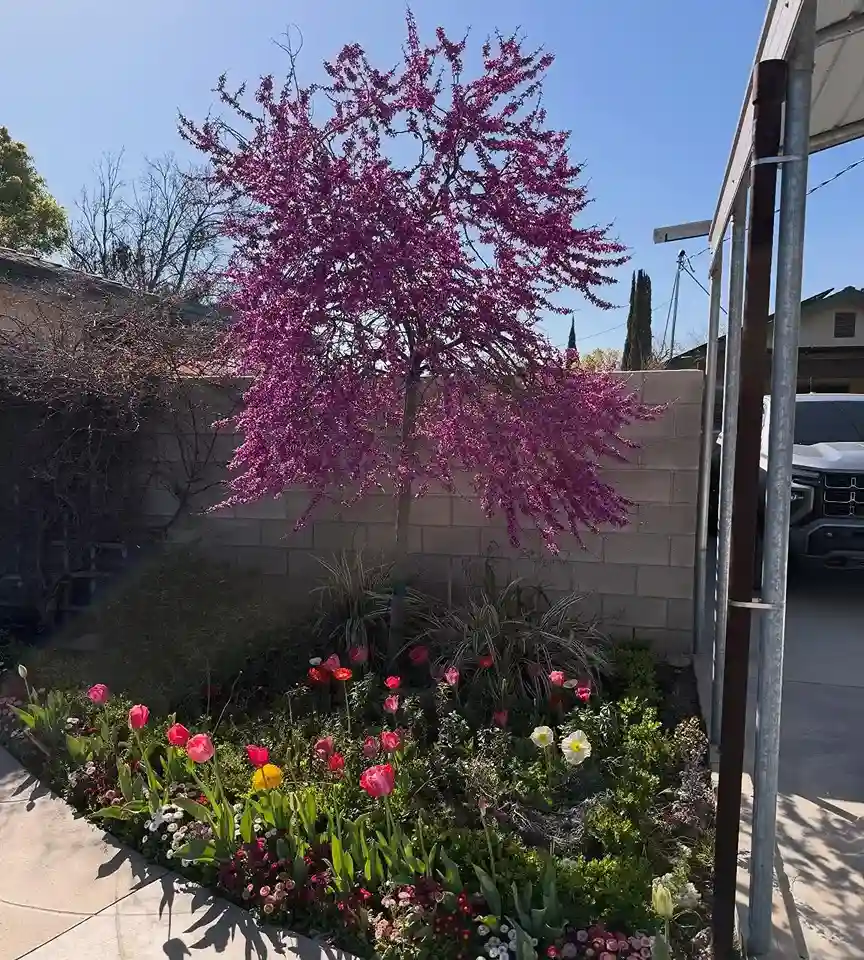
Once the spring show concludes, the Redbud transitions into a lush summer canopy of heart-shaped leaves that offer gentle shade. In cities like Denver and Chicago, this tree is prized for its resilience and its ability to provide brilliant golden-yellow foliage in the autumn. It is a low-maintenance choice that fits perfectly into side of house landscaping projects where a soft, organic texture is needed to balance architectural lines.
2. Japanese Maple (Acer palmatum)
The Japanese Maple is widely regarded as the “sculpture” of the plant world. With hundreds of cultivars available, ranging from the deep burgundy ‘Bloodgood’ to the lacy, lime-green ‘Waterfall’, these trees offer unparalleled diversity in foliage and form. They are particularly well-suited for side yard landscaping ideas because they grow slowly and maintain a graceful, manageable size over decades.
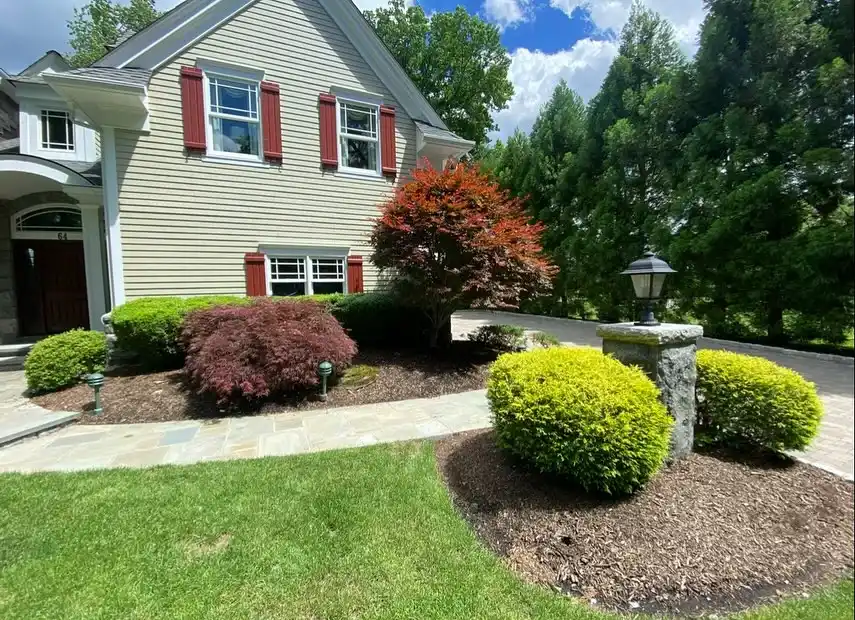
Beyond their beauty, Japanese Maples are highly adaptable to “dappled light” environments. In warmer regions like Los Angeles or San Francisco-Oak-San Jose, they benefit from the protection of shade sail ideas or the shadow of taller buildings. Their delicate leaf structure creates a sophisticated, tranquil atmosphere that complements both modern minimalist designs and traditional vintage garden aesthetics.
3. Star Magnolia (Magnolia stellata)
For homeowners in Seattle-Tacoma or New York who desire a timeless, elegant look, the Star Magnolia is a premier selection. Unlike the massive Southern Magnolia, the Star variety remains a compact 15–20 feet. In late winter or very early spring, it produces an explosion of white, multi-petaled, star-shaped flowers that release a delicate, honey-like fragrance into the crisp morning air.
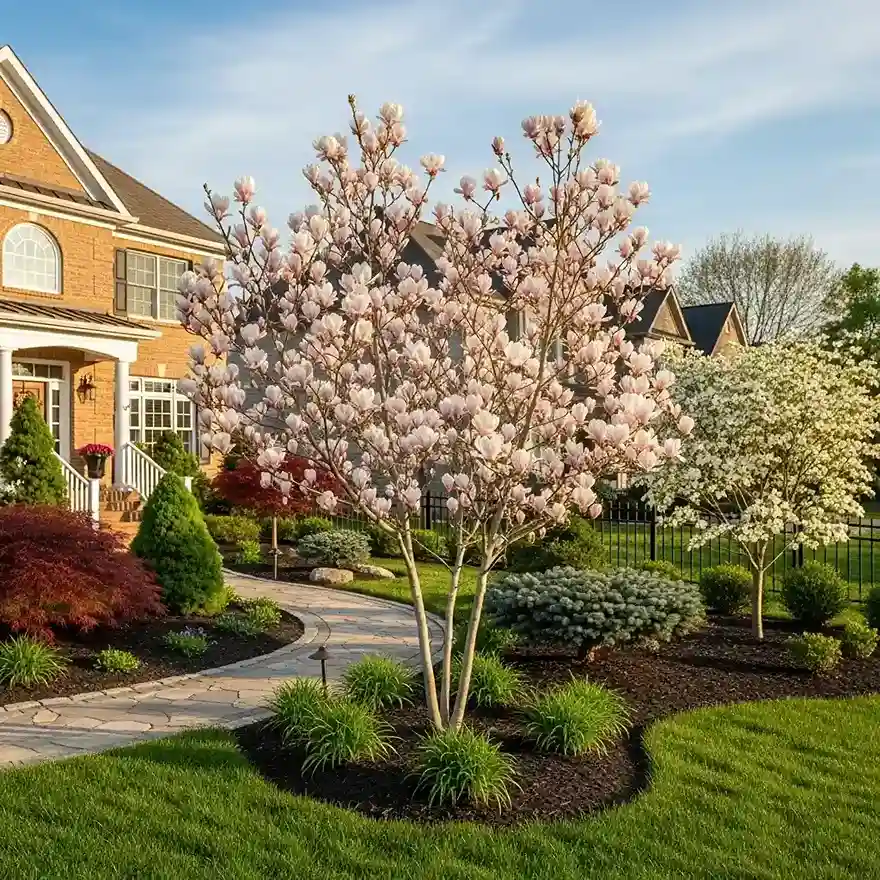
This tree acts as a vital early-season nectar source for pollinators, making it a great addition near a wildlife feeding station ideas. Its slow growth rate and non-invasive root system make it safe to plant near a gravel driveway guide or a stone walkway. After the flowers fade, the tree maintains a clean, dark green leaf canopy that provides a professional backdrop for summer perennials.
4. Serviceberry (Amelanchier)
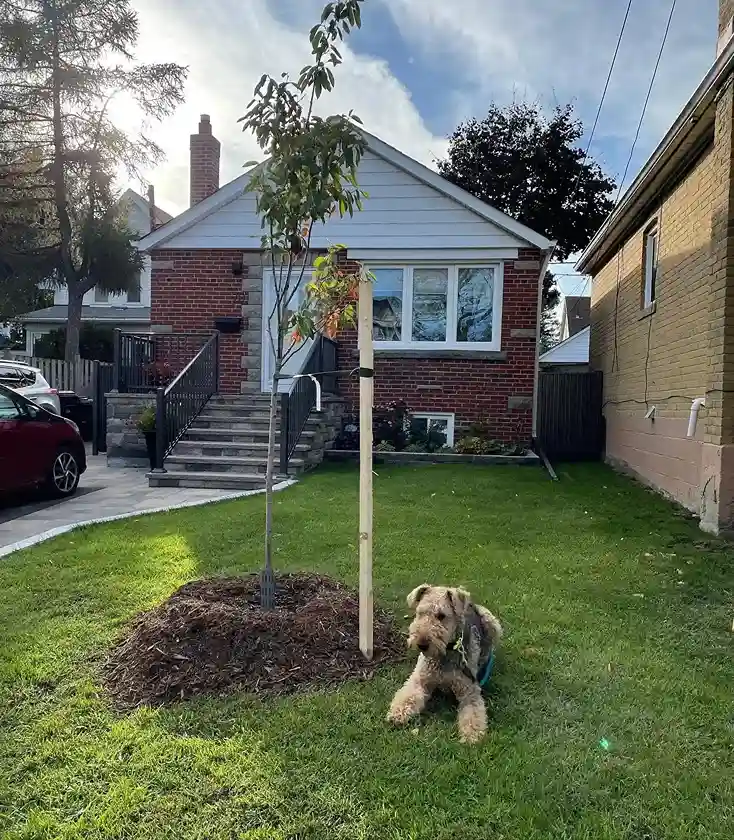
The Serviceberry is a “triple-threat” tree that offers year-round beauty and high utility. In the spring, it is covered in clouds of delicate white flowers; in the summer, it produces delicious, dark purple berries that taste like a cross between a blueberry and an almond. This makes it an essential component for those learning how to create mini food forest systems in small urban plots.
Source: @hankdetamble
In the autumn, the Serviceberry provides some of the most spectacular orange and red foliage found in the American landscape. Its multi-stemmed growth habit gives it a rustic garden ideas feel, which works beautifully as a natural screen. It is incredibly hardy, surviving the harsh winters of Chicago and Denver while still looking delicate and ornamental in a front yard setting.
5. Kousa Dogwood (Cornus kousa)
The Kousa Dogwood is a rugged, disease-resistant alternative to the native American Flowering Dogwood. It blooms slightly later in the season—usually late spring to early summer—extending the flowering window of your landscape. Its bracts (which look like petals) are pointed and elegant, followed by unique, globe-shaped red fruits that add a touch of diy yard decor through natural elements.
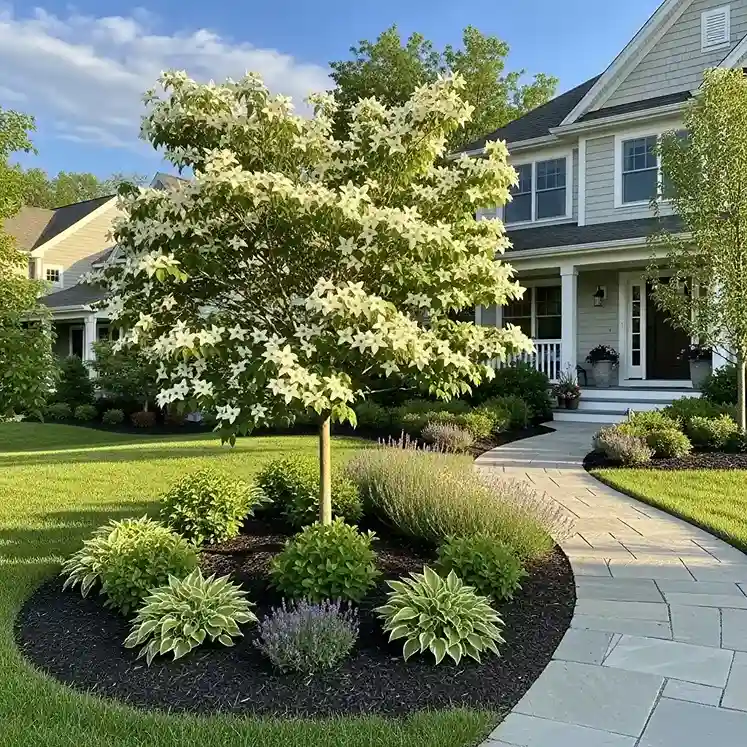
As the tree matures, its bark develops a beautiful exfoliating pattern of tan, brown, and grey, providing visual interest even in the dead of winter. It is an excellent choice for urban hubs like New York because it handles soil compaction and air pollution better than many other flowering trees. Its horizontal branching habit also makes it an effective yard divider ideas when planted in a row.
6. Paperbark Maple (Acer grisium)
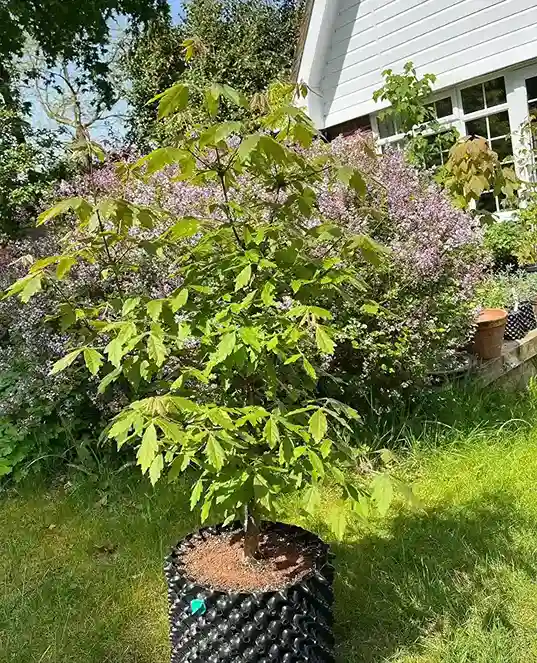
If you are looking for a tree that provides “architectural texture,” the Paperbark Maple is a standout candidate. Its most striking feature is its cinnamon-colored, exfoliating bark that peels away in thin, papery layers, revealing a smooth, lighter orange bark underneath. This feature is especially dramatic in the winter when the tree is bare, looking stunning against the backdrop of a wood and wire fence.
Source: @milesjapanesemaples
The Paperbark Maple is a slow grower that typically reaches about 20–25 feet, making it perfect for framing a front entrance. Its trifoliate leaves turn a brilliant reddish-bronze in the autumn, providing a late-season color boost. Because it is so manageable, it is often used in cinder block garden ideas where space for root expansion is limited but a strong vertical element is needed.
7. Seven-Son Flower (Heptacodium miconioides)
The Seven-Son Flower is a rare and unique choice that is quickly gaining popularity in Phoenix and San Francisco-Oak-San Jose. It offers a “second spring” because it produces clusters of fragrant white flowers in late August and September when most other trees have finished blooming. After the flowers fall, the calyxes turn a vivid cherry-red, making it look like the tree is blooming again in a completely different color.
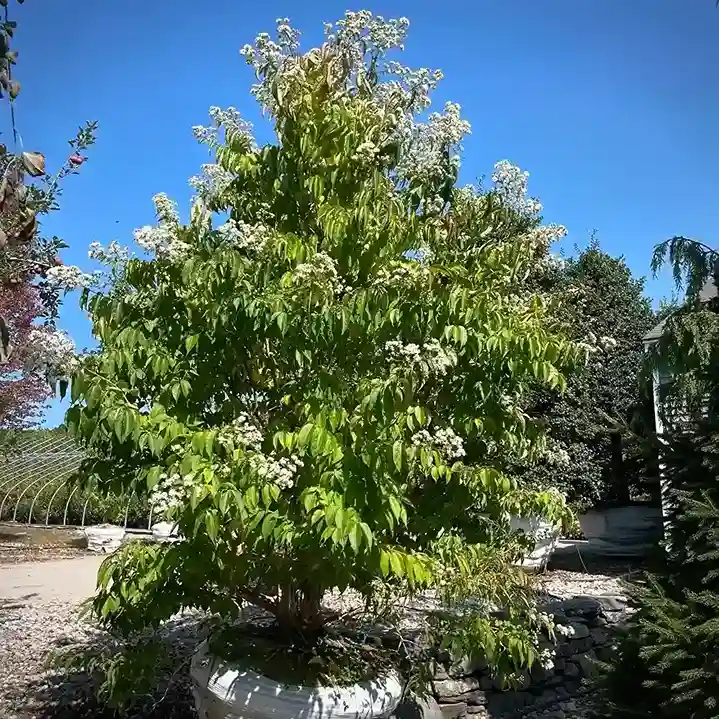
Source: @selecthorticulture
This tree is highly adaptable and can be grown as a single-trunk tree or a multi-stemmed shrub. Its tan, peeling bark adds a layer of sophistication that fits well with a mediterranean garden theme. Because it attracts butterflies and bees during the late summer “dearth,” it is a cornerstone species for ecological gardening in the United States.
8. Skyrocket Juniper (Juniperus scopulorum)
For homeowners with extremely narrow front yards or those looking for backyard privacy ideas in a tight space, the Skyrocket Juniper is the ultimate vertical solution. It grows in a tight, columnar shape, reaching 15–20 feet in height while staying only 2–3 feet wide. This makes it ideal for framing a doorway or lining a driveway ideas project without encroaching on walking space.
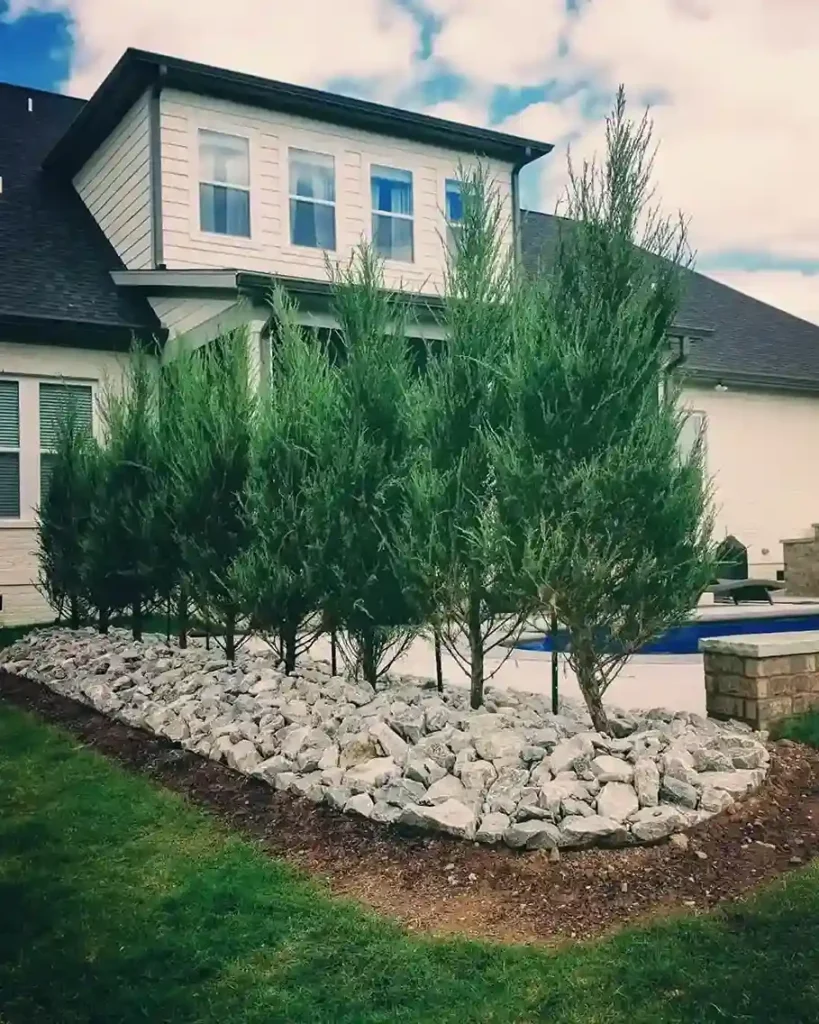
Source: @horticulture_615
The silvery-blue foliage provides a cool, modern color palette that looks sharp year-round. It is incredibly drought-tolerant once established, making it a “Budget-Friendly” and sustainable choice for arid climates like Phoenix. It requires virtually no pruning to maintain its “rocket” shape, providing a low-maintenance architectural element that works well as a living screen or a formal accent.
9. Dwarf Alberta Spruce (Picea glauca ‘Conica’)
The Dwarf Alberta Spruce is the “steady hand” of the gardening world. It grows very slowly—often only 2–3 inches per year—and maintains a perfect, dense conical shape without any human intervention. This makes it a favorite for framing green house interior and exterior ideas or using in symmetrical pairs at the end of a gravel driveway guide.
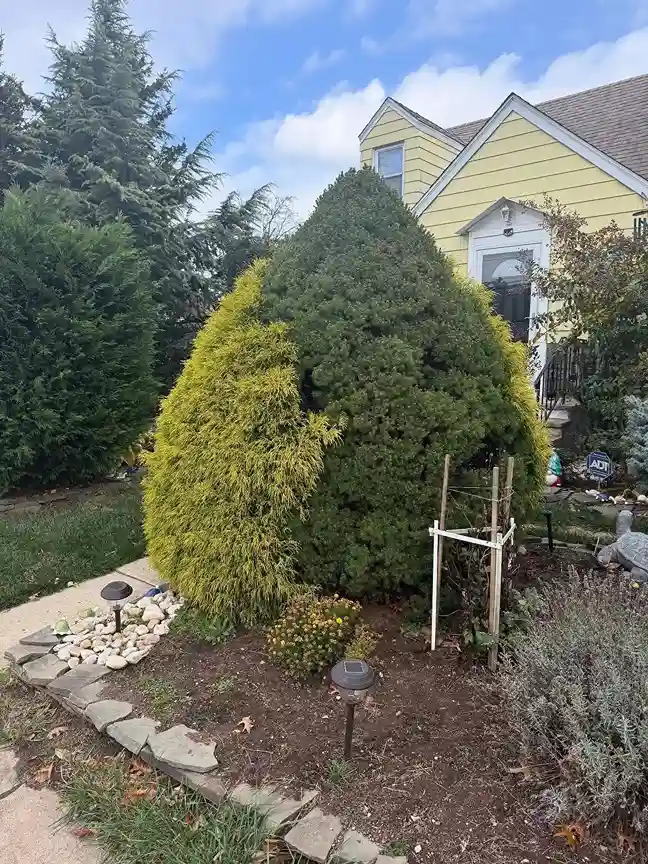
Source: @reptans61
Its fine, bright green needles provide a soft texture that remains vibrant through the coldest winters of Chicago and Denver. Because it stays small (maturing around 10–12 feet after decades), it is a safe choice for planting near foundations or underneath windows. It is also an excellent candidate for winter diy yard decor, as it can be easily decorated with lights during the holiday season.
10. Weeping Cherry (Prunus subhirtella ‘Pendula’)
The Weeping Cherry is a high-drama specimen tree that acts as a focal point for any front yard. Its long, cascading branches sweep toward the ground, and in early spring, they are completely covered in thousands of tiny pink or white flowers. This “flower fountain” effect is unmatched for creating a romantic, vintage garden atmosphere.
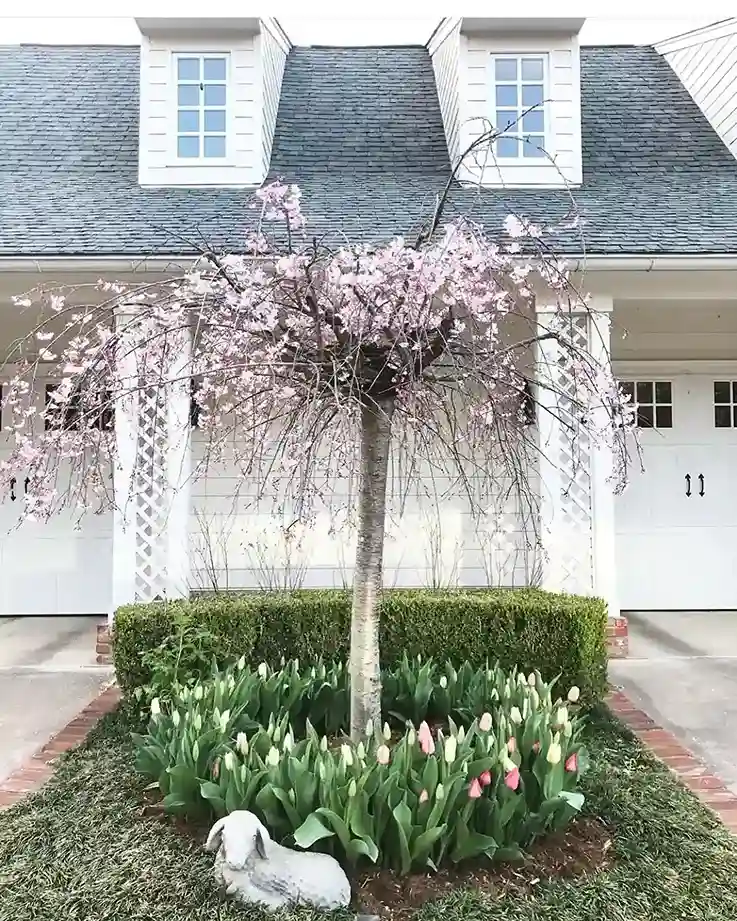
To keep a Weeping Cherry healthy, ensure it is planted in a spot with excellent drainage. If your yard has heavy clay, consider using drainage techniques found in steep hill landscaping to prevent water from sitting at the roots. When the flowers are gone, the tree provides a graceful green canopy that looks beautiful when lit from below with low-voltage landscape lighting at night.
11. American Holly (Ilex opaca)
If you are looking for a tree that provides backyard privacy ideas with the added benefit of winter color, the American Holly is a classic choice. Its thick, spiny evergreen leaves provide a dense screen year-round, while its bright red berries provide a festive pop of color in the winter months. It is a slow grower that can be pruned into a formal shape or allowed to grow into a natural, pyramidal form.
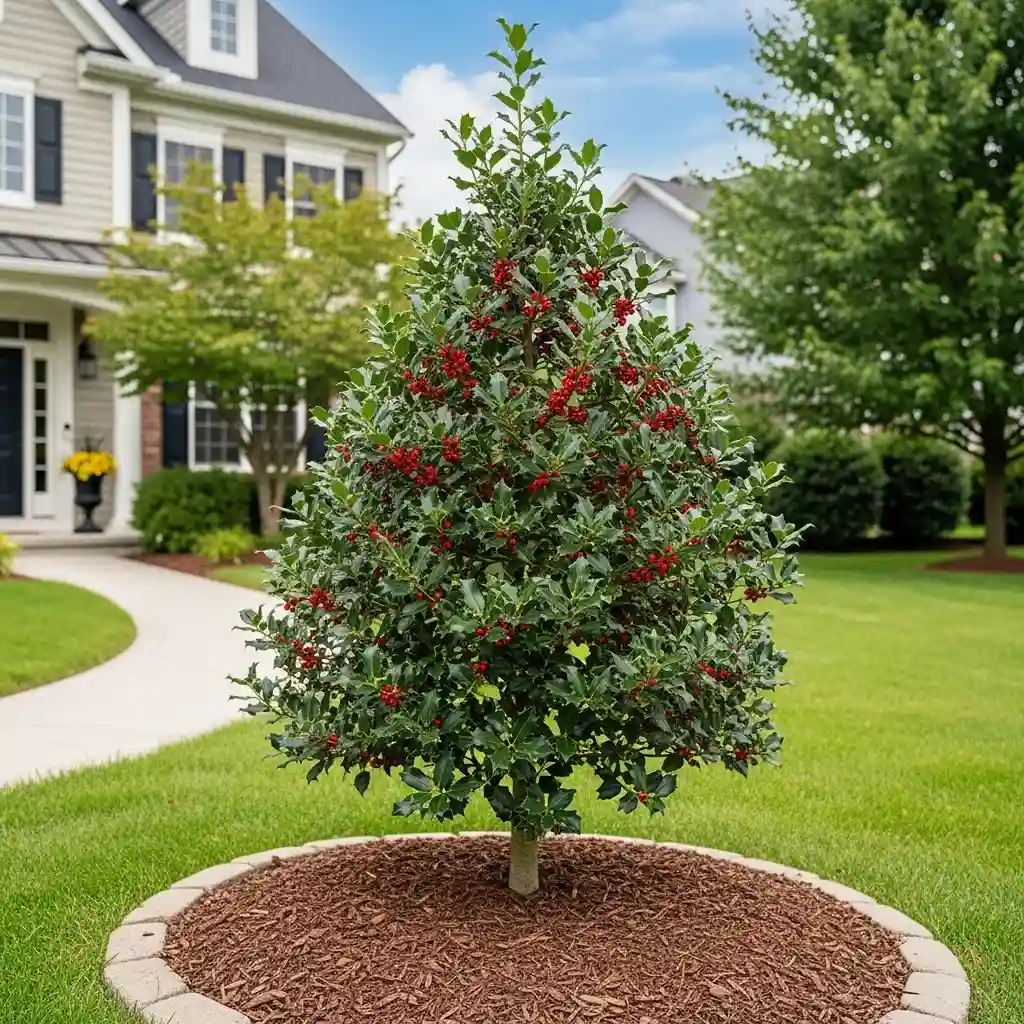
The American Holly is a vital resource for local birds, who rely on the berries for food during the cold months in cities like New York. It is a very resilient tree that can handle a variety of soil types, including the sandy soils often found in coastal Los Angeles. Planting a row of these can also act as an effective noise barrier if your front yard is located near a busy street or intersection.
12. Fringe Tree (Chionanthus virginicus)
The Fringe Tree, often affectionately called “Old Man’s Beard,” produces some of the most unique flowers in the botanical kingdom. In late spring, the tree is draped in masses of feathery, white, fringe-like blooms that give it a “cloud-like” appearance. It is a native American species that is incredibly tough and highly tolerant of urban pollution, making it a top pick for Chicago and New York.
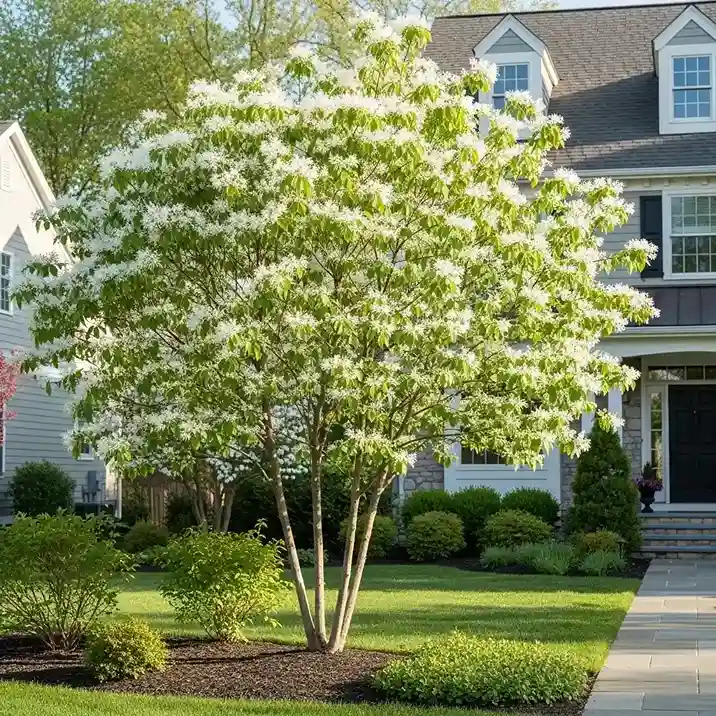
It usually grows as a multi-stemmed tree, reaching a height of 15–20 feet with a similar spread. This makes it an excellent choice for a yard divider ideas between properties. In the fall, its leaves turn a bright, clear yellow, and the female trees produce dark blue fruits that are a favorite of local songbirds and wildlife.
13. Crabapple (Malus ‘Prairie Fire’)
Modern Crabapple varieties like ‘Prairie Fire’ have been bred for intense disease resistance and spectacular color. In the spring, they are smothered in deep pink or red flowers, followed by dark, purplish-green foliage. They are a cornerstone for a wildlife feeding station ideas because their small, colorful fruits persist into the winter, providing a critical food source for birds.
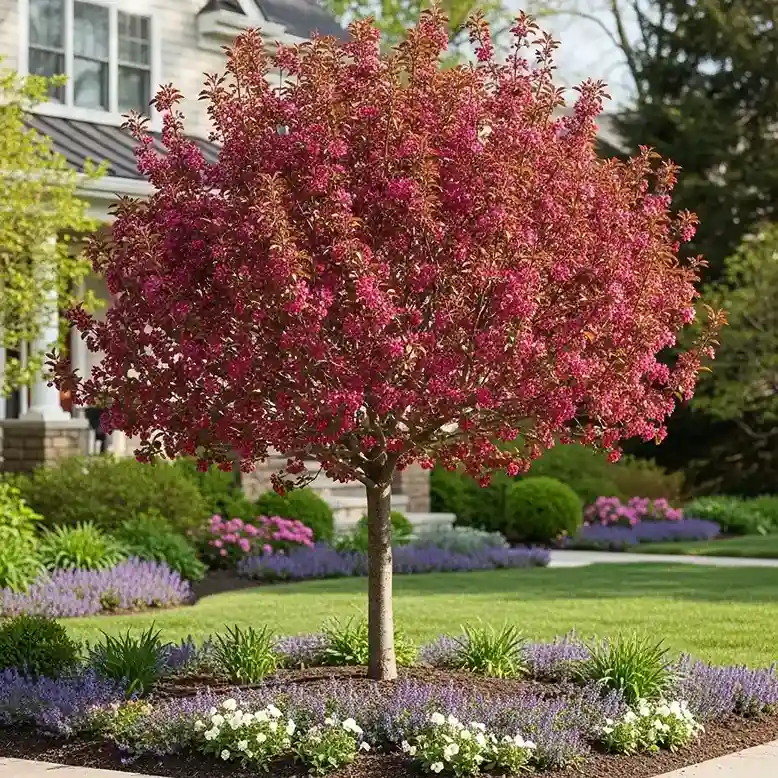
Crabapples are very hardy and can thrive in almost any American hardiness zone. They are a “Budget-Friendly” way to add massive color to a landscape without needing expensive specialized care. Their compact size makes them safe for planting near a chain link fence where they can soften the industrial look of the metal with their organic, rounded canopy.
14. Smoke Tree (Cotinus coggygria)
The Smoke Tree is named for the airy, “smoke-like” puffs of flower clusters that appear in mid-summer. These clusters stay on the tree for weeks, providing a unique texture that contrasts beautifully with traditional broadleaf trees. Varieties like ‘Royal Purple’ offer deep, wine-red foliage that holds its color throughout the heat of a Los Angeles or Phoenix summer.
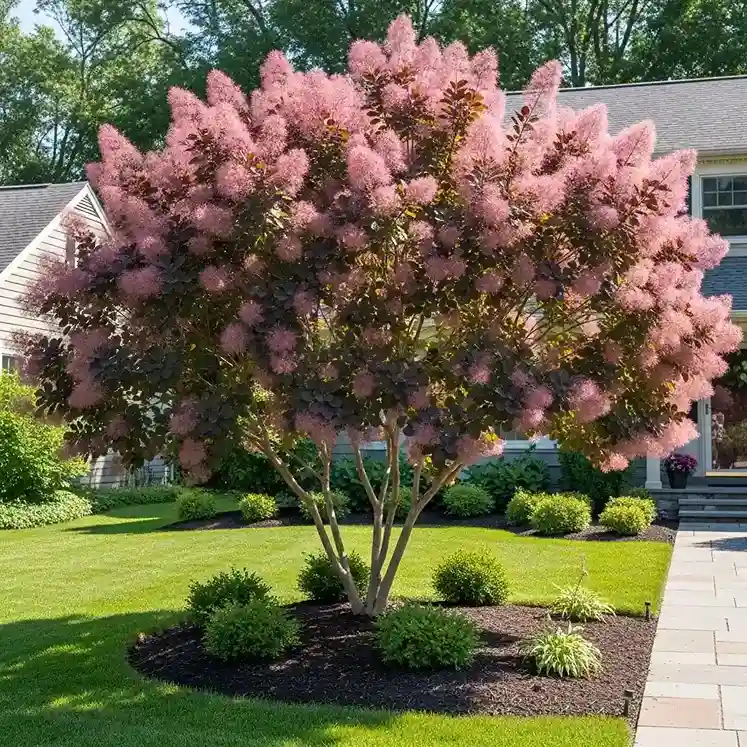
Because it is exceptionally drought-tolerant once established, the Smoke Tree is a key player in sustainable and mediterranean garden designs. It can be pruned heavily to maintain a smaller size or allowed to grow into a wide-spreading 15-foot tree. Its bold color makes it a perfect focal point for a modern front yard that needs a “pop” of unconventional interest.
15. Chaste Tree (Vitex agnus-castus)
The Chaste Tree is a Mediterranean native that has become a favorite in the Southern and Western United States. It produces long, upright spikes of lavender-blue flowers in the middle of summer when most other flowering trees have gone dormant. It is a magnet for butterflies, hummingbirds, and bees, making it a high-value ecological asset for any permaculture garden design.
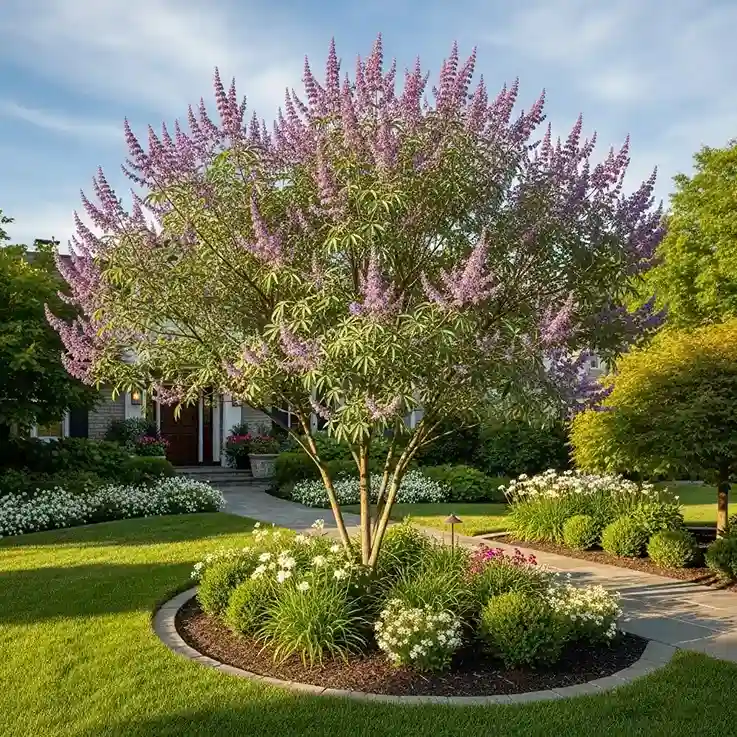
It thrives in the intense heat and sun of Phoenix and Los Angeles, but can also be grown as a “die-back” shrub in colder cities like Chicago. Its aromatic, sage-green leaves have a palm-like shape that adds an exotic, tropical feel to the landscape. It is a fast grower, so it can provide a sense of “instant landscape” for homeowners looking for a quick curb appeal boost.
16. Cornelian Cherry Dogwood (Cornus mas)
Rounding out our list is the Cornelian Cherry, a dogwood that offers one of the earliest signs of spring. In late February or early March, before any other tree has woken up, it produces clusters of tiny, bright yellow flowers. This provides a much-needed burst of color in the late winter landscapes of Denver and New York.
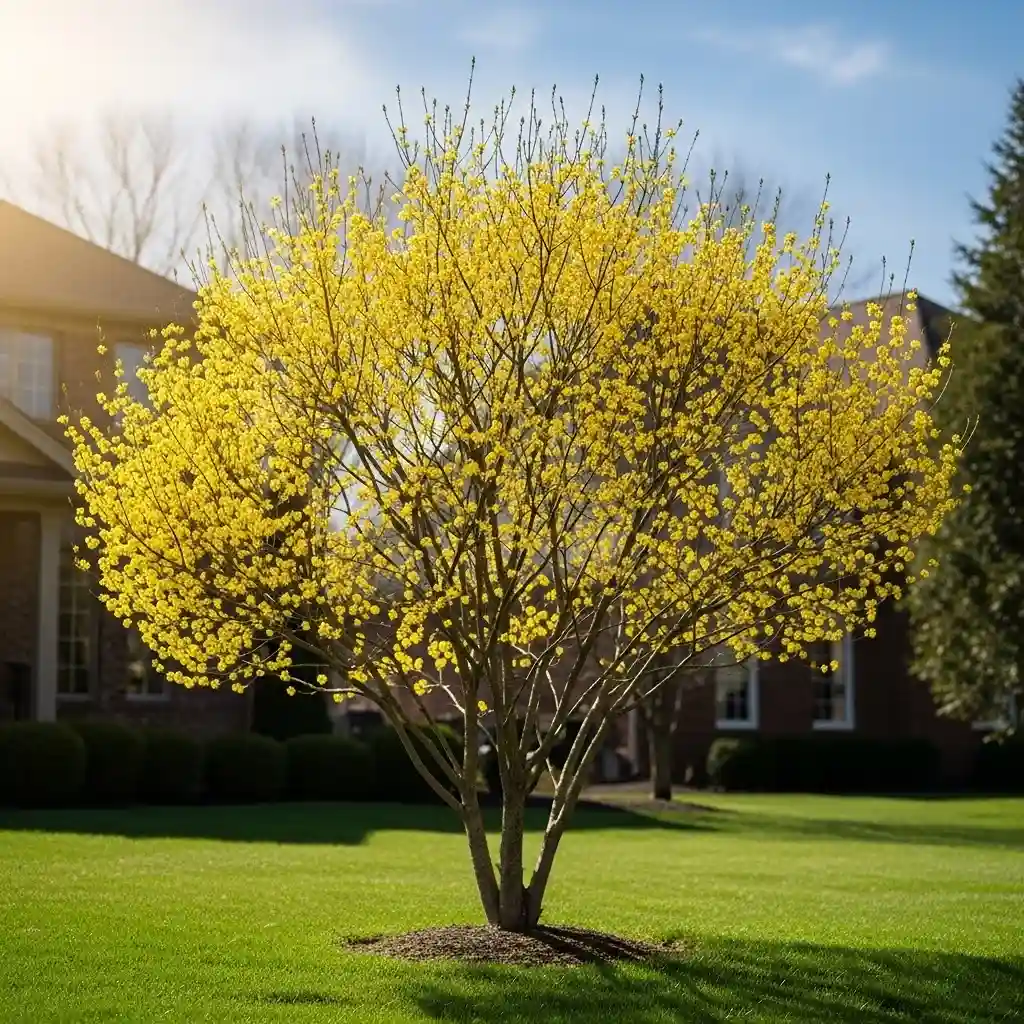
In late summer, it produces bright red, edible fruits that can be used for preserves, adding a functional “food forest” element to your yard. The tree is very long-lived and develops a beautiful, gnarled structure over time that works well in a rustic garden ideas theme. It is highly resistant to the pests and diseases that often plague other flowering trees, making it a low-stress choice for any gardener.
Technical Comparison of Small Tree Varieties
To help you choose the right tree for your specific American region, refer to the data below. This table highlights the core environmental needs and aesthetic outputs for each variety.
| Tree Name | USDA Zone | Sun Requirement | Best Regional Hub |
| Eastern Redbud | 4–9 | Full Sun / Part Shade | Chicago, Denver |
| Japanese Maple | 5–8 | Dappled Shade | San Francisco, Seattle |
| Skyrocket Juniper | 4–9 | Full Sun | Phoenix, Los Angeles |
| Serviceberry | 4–9 | Full Sun / Part Shade | New York, Chicago |
| Smoke Tree | 5–8 | Full Sun | Los Angeles, Phoenix |
| Star Magnolia | 4–8 | Full Sun | Seattle, New York |
Professional Design Strategies: How to Place Your Tree
1. The Rule of Framing
One of the most common mistakes in front yard landscaping is planting a tree directly in front of a primary window. This blocks natural light and obscures the architectural “face” of your home. Instead, use small trees to “frame” the house by planting them near the corners. This softens the transition between the building and the lawn, making the house feel more integrated into the landscape.
2. Layering for Depth
Don’t let your tree stand alone in a sea of grass. Create a “planting bed” around the base of the tree and fill it with mid-level shrubs and groundcovers. For a modern look, consider integrating cinder block garden ideas for the edging or using a gravel driveway guide style to create a clean, rocky mulch layer that suppresses weeds and retains moisture.
3. Managing Vertical Space
Before you dig, look up. Ensure that your chosen tree’s mature height won’t interfere with power lines or eaves. If you are planting in a narrow strip between your home and a wood and wire fence, select a columnar variety like the Skyrocket Juniper. This ensures you get the height you want without the horizontal spread that could cause property line disputes.
Frequently Asked Questions
What is the best time of year to plant a front yard tree?
In most American climates, late fall or early spring is the ideal time to plant. This allows the roots to establish themselves while the tree is dormant or just waking up, avoiding the stress of summer heat. If you are in a frost-free zone like Los Angeles, you can plant almost year-round, but autumn is still preferred to take advantage of the winter rains.
How do I ensure my tree doesn’t damage my driveway or foundation?
Small trees are generally much safer than large oaks or maples, but you should still follow the “half-width rule.” Plant the tree at least half of its expected mature canopy width away from any structure. For example, if a Japanese Maple grows 15 feet wide, plant it at least 7.5 feet away from your gravel driveway guide or foundation.
Can I grow these trees if I have a very steep front yard?
Yes, but you will need to apply steep hill landscaping techniques. This involves creating a small “terrace” or a “well” on the downhill side of the tree to capture water. This ensures that the water soaks into the root ball instead of running off the surface, which is critical for the tree’s survival in its first two years.
What is the most budget-friendly way to buy a tree?
The most cost-effective way is to buy “bare-root” trees during the winter months. These are trees that are shipped without soil and are much cheaper than “potted” or “balled and burlapped” trees. While they look like sticks initially, they establish quickly and are a great way to save 30-50% on your landscape costs.
How do I revive a newly planted tree that looks stressed?
“Transplant shock” is common. Ensure you haven’t planted the tree too deep—the root flare (where the trunk widens at the base) should always be visible. Much like the delicate care needed for indoor plants, such as knowing how to revive an orchid, monitoring soil moisture is the most important factor in a tree’s recovery.
Conclusion
Transforming your front yard with a small tree is a powerful way to increase property value and personal enjoyment. By choosing one of these 16 varieties, you are selecting a plant that has been vetted for the specific challenges of the American environment—whether that’s the intense sun of Phoenix, the urban density of New York, or the seasonal shifts of Chicago.
Remember that a tree is a living part of your home’s ecosystem. By combining your tree with thoughtful permaculture garden design and proper infrastructure like a backyard fence or a stone path, you create a harmonious outdoor space that will thrive for decades. Whether you’re looking for vibrant spring blooms, a whimsical garden, or year-round evergreen privacy, the perfect small tree is waiting to take root in your garden.