Shade gardening presents unique opportunities to cultivate stunning shade plants that flourish in low-light conditions where sun-loving varieties struggle and fail.
These shade-tolerant species have adapted to forest floors and woodland understories, developing characteristics like larger leaves for maximum photosynthesis, deeper greens capturing limited light, and subtle flowers attracting pollinators in dimly lit environments.

Source: @chipsgardens
Shade gardens offer distinct advantages including reduced watering requirements, minimal weeding due to slower weed growth, and cooler temperatures creating comfortable outdoor spaces during hot summers.
These low-maintenance areas showcase foliage textures, variegations, and subtle flower beauty often overlooked in sun garden’s riot of bright colors. Embracing shade gardening transforms problem areas into assets celebrating nature’s quieter, more refined beauty through thoughtfully selected shade-loving plants.

Source: @thecontainedgarden
1. Hostas Foliage Favorites
Hostas provide unmatched foliage variety in greens, blues, golds, and variegated combinations creating stunning displays in partial to full shade. These perennial favorites range from miniature 4-inch plants to giant 3-foot specimens offering sizes suiting every garden need. The textured leaves in smooth, puckered, or wavy forms add dimensional interest beyond color variations.

Source: @chipsgardens
Hostas produce lavender or white flower spikes in summer though most gardeners grow them primarily for foliage impact throughout seasons. These adaptable plants tolerate various soil conditions thriving with consistent moisture and organic-rich soil. Hostas work beautifully in cottage garden ideas creating lush understory plantings beneath trees and shrubs providing continuous foliage interest.
Care Requirements: Plant in partial to full shade with consistent moisture. Fertilize in spring with balanced fertilizer. Divide every 3-5 years maintaining vigor. Watch for slug and deer damage.
| Feature | Details |
|---|---|
| Light Requirements | Partial to Full Shade |
| Height | 6 inches to 3 feet (variety dependent) |
| Foliage Colors | Green, Blue, Gold, Variegated |
| Hardiness Zones | 3-9 |
| Special Notes | Deer and slug problems, hundreds of varieties |
2. Ferns Textural Interest
Ferns bring delicate feathery textures creating airy contrast against broad-leaved companions in shaded gardens. These ancient plants thrive in moist shade conditions naturalizing beneath trees and along stream banks. Popular varieties including Japanese painted fern, autumn fern, and lady fern offer different textures, colors, and heights suiting various design needs throughout landscapes.

Source: @marayplants_enterprise
Most ferns prefer consistent moisture and acidic soil rich in organic matter mimicking woodland conditions. The unfurling fiddleheads in spring provide additional seasonal interest before fronds fully develop. These low-maintenance perennials require minimal care once established in appropriate locations making them ideal for small garden ideas maximizing limited shade spaces effectively.
Care Requirements: Plant in partial to full shade with consistent moisture. Amend soil with compost or leaf mold. Remove dead fronds in spring before new growth emerges.
| Feature | Details |
|---|---|
| Light Requirements | Partial to Full Shade |
| Height | 1-4 feet (variety dependent) |
| Foliage Colors | Green, Blue-gray, Burgundy, Variegated |
| Hardiness Zones | 3-9 (variety dependent) |
| Special Notes | Native options available, deer-resistant |
3. Astilbe Feathery Plumes
Astilbe produces feathery flower plumes in pink, white, red, and purple rising above fern-like foliage in summer creating colorful shade displays. These moisture-loving perennials thrive in partial shade with consistent water providing reliable blooming year after year. The fluffy flowers attract butterflies while seed heads persist into fall adding continued interest.

Astilbe’s divided foliage provides textural interest even when not flowering throughout growing seasons. These clump-forming perennials gradually expand without becoming invasive making them excellent border plants. The flowers work beautifully in cutting gardens providing long-lasting arrangements. Astilbes suit backyard landscaping ideas creating lush perennial borders in shaded areas where other flowering plants struggle.
Care Requirements: Plant in partial shade with rich, moist soil. Mulch to retain moisture. Fertilize in spring. Divide every 3-4 years maintaining blooming vigor.
| Feature | Details |
|---|---|
| Light Requirements | Partial Shade |
| Height | 1-4 feet (variety dependent) |
| Bloom Colors | Pink, White, Red, Purple |
| Hardiness Zones | 3-8 |
| Bloom Time | Early to Mid-Summer |
4. Coral Bells Colorful Foliage
Coral bells (Heuchera) provide year-round foliage interest in purple, burgundy, lime, coral, and silver creating colorful groundcovers and border fronts. Modern hybrids offer incredible color range surpassing original green-leaved species. Delicate flower wands rise above foliage in spring attracting hummingbirds while the leaves remain attractive throughout seasons.

These versatile perennials tolerate partial shade to sun with afternoon shade in hot climates preventing leaf scorch. The mounding habit creates tidy plants requiring minimal maintenance beyond removing spent flower stalks. Coral bells work beautifully in containers and mass plantings providing consistent color where seasonal flowers fade. Mix varieties creating tapestries of contrasting foliage colors.
Care Requirements: Plant in partial shade with well-drained soil. Fertilize lightly in spring. Remove spent flower stalks. Replant crowns every 3 years preventing woody centers.
| Feature | Details |
|---|---|
| Light Requirements | Partial Shade to Sun |
| Height | 8-18 inches |
| Foliage Colors | Purple, Burgundy, Lime, Coral, Silver |
| Hardiness Zones | 4-9 |
| Special Notes | Attracts hummingbirds, deer-resistant |
5. Bleeding Heart Spring Beauty
Bleeding heart produces distinctive heart-shaped flowers dangling from arching stems in pink, white, or bi-colors creating romantic spring displays. These woodland perennials prefer partial to full shade with cool, moist conditions thriving beneath deciduous trees. The fern-like foliage remains attractive after flowering though plants may go dormant in summer heat.

Traditional bleeding heart (Dicentra spectabilis) provides bold presence while fringed bleeding heart (Dicentra eximia) offers finer foliage and repeat blooming into fall. Both types create excellent companions for spring bulbs and later-blooming shade perennials filling seasonal gaps. The unique flowers make memorable spring statements in woodland gardens and shaded borders throughout properties.
Care Requirements: Plant in partial to full shade with rich, moist soil. Fertilize in early spring. Allow dormancy in summer or provide consistent moisture preventing dieback.
| Feature | Details |
|---|---|
| Light Requirements | Partial to Full Shade |
| Height | 1-3 feet |
| Bloom Colors | Pink, White, Bi-color |
| Hardiness Zones | 3-9 |
| Bloom Time | Spring (April-June) |
6. Brunnera Silver Foliage
Brunnera produces delicate blue forget-me-not flowers in spring above heart-shaped leaves often featuring silver markings and variegations. This low-maintenance perennial thrives in partial shade creating attractive groundcover spreading slowly through rhizomes. The silver-splashed foliage varieties brighten dark areas throughout entire growing seasons beyond brief spring flowering.

‘Jack Frost’ and ‘Sea Heart’ offer stunning silver foliage with green veining creating living artwork in shade gardens. These drought-tolerant plants once established require minimal care while providing reliable beauty year after year. Brunnera works beautifully in front yard landscaping creating elegant foundation plantings in shaded areas where grass struggles to grow successfully.
Care Requirements: Plant in partial shade with average to moist soil. Fertilize lightly in spring. Remove spent flowers and damaged leaves maintaining appearances throughout seasons.
| Feature | Details |
|---|---|
| Light Requirements | Partial Shade |
| Height | 12-18 inches |
| Bloom Colors | Blue |
| Hardiness Zones | 3-8 |
| Special Notes | Silver foliage varieties available, deer-resistant |
7. Solomon’s Seal Arching Elegance
Solomon’s seal produces graceful arching stems lined with oval leaves and small white bell-shaped flowers dangling beneath in spring. This native perennial naturalizes in woodland settings creating elegant colonies over time through spreading rhizomes. Blue-black berries follow flowers in fall while leaves turn golden-yellow before dormancy adding seasonal interest.

Variegated Solomon’s seal offers white-edged foliage brightening deep shade throughout growing seasons. These tall perennials provide vertical interest in shade gardens while the arching form creates movement and grace. The low-maintenance nature and native status make Solomon’s seal valuable for supporting local ecosystems while creating beautiful naturalistic plantings.
Care Requirements: Plant in partial to full shade with moist, organic-rich soil. Fertilize in spring with compost. Allow natural spreading or divide to control size.
| Feature | Details |
|---|---|
| Light Requirements | Partial to Full Shade |
| Height | 1-3 feet |
| Bloom Colors | White |
| Hardiness Zones | 3-9 |
| Special Notes | Native, variegated forms available, spreads slowly |
8. Lungwort Spotted Foliage
Lungwort produces pink buds opening to blue flowers in early spring creating unique two-toned displays. The spotted or silver-splashed foliage remains attractive throughout seasons after flowering providing continued interest. These low-growing perennials create excellent groundcovers in partial to full shade spreading slowly forming dense mats suppressing weeds naturally.

Modern cultivars offer improved mildew resistance and more dramatic foliage patterns than older varieties. The early flowering provides nectar when few sources exist while spotted leaves brighten shaded areas throughout growing seasons. Lungwort tolerates dry shade once established making it valuable for challenging sites under trees with competitive root systems.
Care Requirements: Plant in partial to full shade with average to moist soil. Fertilize lightly in spring. Remove spent flowers and damaged leaves after blooming maintaining fresh appearances.
| Feature | Details |
|---|---|
| Light Requirements | Partial to Full Shade |
| Height | 8-12 inches |
| Bloom Colors | Pink, Blue, White |
| Hardiness Zones | 3-8 |
| Bloom Time | Early Spring |
9. Japanese Forest Grass
Japanese forest grass provides graceful arching foliage in chartreuse, gold, or variegated patterns creating glowing accents in shade gardens. This clump-forming ornamental grass thrives in partial shade where most grasses fail providing movement and fine texture. The cascading habit creates fountain-like forms brightening dark corners with luminous foliage colors.

‘Aureola’ offers bright golden foliage with narrow green stripes creating stunning displays in shaded areas. These slow-growing grasses require minimal care beyond removing dead foliage in spring before new growth emerges. Japanese forest grass works beautifully in containers and border fronts providing consistent color and texture throughout growing seasons without demanding maintenance.
Care Requirements: Plant in partial shade with moist, well-drained soil. Fertilize lightly in spring. Cut back dead foliage in early spring before new growth begins.
| Feature | Details |
|---|---|
| Light Requirements | Partial Shade |
| Height | 12-18 inches |
| Foliage Colors | Chartreuse, Gold, Variegated |
| Hardiness Zones | 5-9 |
| Special Notes | Slow-growing, deer-resistant |
10. Foamflower Native Groundcover
Foamflower produces fuzzy white or pink flower spikes in spring above attractive mapleleaf-shaped foliage creating native groundcovers. These low-growing perennials spread through runners forming dense mats suppressing weeds while providing continuous foliage interest. Many varieties offer burgundy leaf markings and color-changing fall foliage adding multi-season appeal beyond spring flowering.
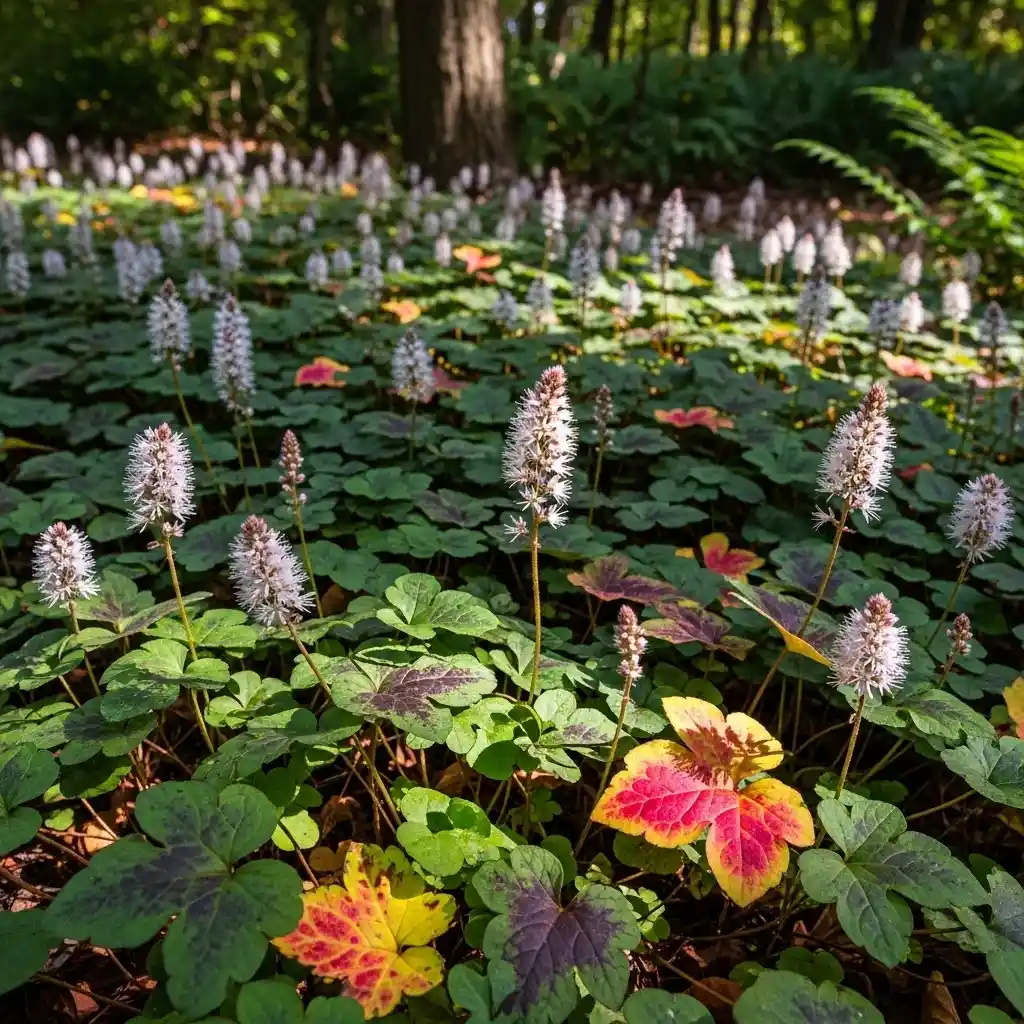
Native Tiarella species support local ecosystems providing nectar and habitat for beneficial insects. These versatile plants tolerate dry shade once established making them valuable for challenging sites beneath mature trees. Foamflower works beautifully in woodland garden settings creating naturalistic plantings celebrating regional flora while requiring minimal maintenance once established successfully.
Care Requirements: Plant in partial to full shade with moist, organic soil. Fertilize lightly in spring. Divide every few years controlling spread and maintaining vigor.
| Feature | Details |
|---|---|
| Light Requirements | Partial to Full Shade |
| Height | 6-12 inches |
| Bloom Colors | White, Pink |
| Hardiness Zones | 3-8 |
| Special Notes | Native, evergreen in mild climates, spreads moderately |
11. Liriope Evergreen Border
Liriope provides evergreen grass-like foliage and purple or white flower spikes in late summer creating durable borders and groundcovers. These tough perennials tolerate deep shade, drought, and competition from tree roots thriving where other plants fail. The clumping or spreading types offer different growth habits suiting various landscape applications from edging to mass plantings.

Variegated varieties brighten shaded areas with white or yellow-striped foliage maintaining interest year-round. Liriope requires minimal maintenance beyond cutting back old foliage in late winter before new growth emerges. The reliable performance and evergreen nature make it valuable for fence line landscaping creating consistent borders requiring minimal ongoing care.
Care Requirements: Plant in partial to full shade with average soil. Fertilize lightly in spring. Cut back foliage in late winter. Divide clumps every 3-4 years.
| Feature | Details |
|---|---|
| Light Requirements | Partial to Full Shade |
| Height | 10-18 inches |
| Bloom Colors | Purple, White |
| Hardiness Zones | 5-10 |
| Special Notes | Evergreen, very drought-tolerant once established |
12. Hellebores Winter Blooms
Hellebores produce rose-like flowers in winter through spring in white, pink, purple, and green providing color when few plants bloom. These evergreen perennials thrive in partial to full shade with well-drained soil tolerating dry shade once established. The leathery foliage remains attractive year-round while flowers persist for months creating extended displays.

Lenten rose (Helleborus orientalis) offers easiest cultivation and widest color range while Christmas rose (Helleborus niger) blooms earliest in mild winters. These long-lived perennials resent disturbance once established, so choose planting locations carefully. Hellebores work beautifully in cottage garden ideas providing early season interest beneath deciduous shrubs and trees.
Care Requirements: Plant in partial to full shade with well-drained soil. Fertilize lightly in fall. Remove damaged foliage in late winter before flowering.
| Feature | Details |
|---|---|
| Light Requirements | Partial to Full Shade |
| Height | 12-18 inches |
| Bloom Colors | White, Pink, Purple, Green, Burgundy |
| Hardiness Zones | 4-9 |
| Bloom Time | Winter-Spring (December-April) |
13. Pachysandra Japanese Spurge
Pachysandra creates dense evergreen groundcover in partial to full shade suppressing weeds while requiring minimal maintenance. These low-growing perennials spread through underground runners forming thick mats covering large areas effectively. Small white flowers appear in spring though plants are grown primarily for glossy foliage creating uniform green carpets.

This traditional groundcover tolerates dry shade and tree root competition thriving where grass fails. Variegated varieties offer white-edged foliage brightening dark areas. While some consider pachysandra overused, its reliable performance under challenging conditions justifies continued popularity. The evergreen nature provides year-round coverage requiring only occasional trimming maintaining neat edges.
Care Requirements: Plant in partial to full shade with average soil. Fertilize lightly in spring. Trim edges annually maintaining boundaries. Thin if overgrown.
| Feature | Details |
|---|---|
| Light Requirements | Partial to Full Shade |
| Height | 6-8 inches |
| Foliage | Glossy Green, Variegated forms available |
| Hardiness Zones | 4-9 |
| Special Notes | Evergreen, spreads vigorously, very low maintenance |
14. Columbine Delicate Flowers
Columbine produces unique spurred flowers in spring in nearly every color imaginable attracting hummingbirds to shade gardens. These short-lived perennials readily self-seed ensuring continued presence while delicate foliage remains attractive after flowering. Native and hybrid varieties offer different flower forms and colors suiting various garden styles from woodland to cottage.

The airy flowers dance above mounding foliage creating whimsical displays in partial shade. Columbine tolerates various soil conditions thriving with minimal care once established. These charming perennials work beautifully in small garden ideas providing vertical interest and hummingbird attraction without requiring significant space or demanding maintenance throughout seasons.
Care Requirements: Plant in partial shade with well-drained soil. Allow self-seeding for continued presence. Remove spent foliage after flowering. Watch for leaf miners.
| Feature | Details |
|---|---|
| Light Requirements | Partial Shade to Sun |
| Height | 1-3 feet |
| Bloom Colors | Red, Yellow, Blue, Pink, White, Bi-color |
| Hardiness Zones | 3-9 |
| Bloom Time | Spring (April-June) |
15. Caladium Tropical Drama
Caladiums provide bold tropical foliage in pink, red, white, and green creating dramatic displays in shade gardens during summer. These tender bulbs thrive in partial to full shade with consistent moisture producing large arrow or heart-shaped leaves. The vibrant colors and patterns rival any flower creating living artwork in shaded beds and containers.

Dig and store bulbs before frost in cold climates or treat as annuals purchasing fresh bulbs annually. Modern sun-tolerant varieties expand planting possibilities though most perform best in shade. Caladiums work beautifully in containers and mass plantings providing consistent summer color where flowering plants struggle. The tropical appearance suits hippie garden bohemian outdoor aesthetics celebrating bold colors.
Care Requirements: Plant after soil warms in spring. Provide consistent moisture and humidity. Fertilize monthly during growing season. Dig before frost or treat as annual.
| Feature | Details |
|---|---|
| Light Requirements | Partial to Full Shade |
| Height | 12-24 inches |
| Foliage Colors | Pink, Red, White, Green combinations |
| Hardiness Zones | 9-11 (grown as annual elsewhere) |
| Special Notes | Tropical appearance, needs warm temperatures |
16. Epimedium Fairy Wings
Epimedium produces delicate flowers resembling fairy wings in spring in pink, yellow, white, or red hovering above heart-shaped foliage. These low-growing perennials create excellent groundcovers in dry shade spreading slowly through rhizomes. The foliage often features burgundy tints in spring and fall adding multi-season interest beyond brief flowering periods.

These tough plants tolerate tree root competition and dry shade once established making them valuable for challenging sites. The semi-evergreen foliage in mild climates provides year-round coverage. Epimedium works beautifully beneath trees and shrubs creating attractive groundcovers requiring minimal maintenance once established in appropriate shaded locations throughout properties.
Care Requirements: Plant in partial to full shade with well-drained soil. Cut back old foliage in late winter before flowering. Fertilize lightly in spring.
| Feature | Details |
|---|---|
| Light Requirements | Partial to Full Shade |
| Height | 8-12 inches |
| Bloom Colors | Pink, Yellow, White, Red |
| Hardiness Zones | 4-9 |
| Special Notes | Drought-tolerant once established, deer-resistant |
17. Impatiens Continuous Color
Impatiens provide continuous blooms from spring through frost in shade gardens in nearly every color imaginable. These popular annuals thrive in partial to full shade with consistent moisture creating reliable color where perennials finish flowering. Modern varieties offer improved disease resistance addressing downy mildew concerns that plagued traditional types in recent years.

New Guinea impatiens tolerate more sun while providing larger flowers and often colorful foliage. These container favorites create instant impact in hanging baskets and mixed planters. Impatiens work beautifully providing seasonal color in backyard landscaping ideas filling gaps between perennials while ensuring continuous blooming throughout entire growing seasons without demanding constant deadheading.
Care Requirements: Plant after frost danger passes. Provide consistent moisture and shade. Fertilize every 2 weeks with balanced fertilizer. Pinch to encourage bushiness.
| Feature | Details |
|---|---|
| Light Requirements | Partial to Full Shade |
| Height | 6-24 inches (variety dependent) |
| Bloom Colors | All colors except true blue |
| Hardiness Zones | Annual (perennial in zone 10-11) |
| Bloom Time | Spring-Frost |
18. Begonia Versatile Bloomer
Begonias offer incredible variety including fibrous, tuberous, and Rex types providing flowers or foliage in shade gardens. Wax begonias produce continuous blooms in red, pink, or white with glossy green or bronze foliage thriving in partial shade. Tuberous begonias offer large rose-like flowers while Rex begonias provide spectacular foliage patterns in metallic silvers, purples, and pinks.

These versatile plants excel in containers and beds providing consistent color throughout growing seasons. Most begonias thrive in partial shade with consistent moisture though requirements vary by type. The wide selection allows creating entire shade gardens using only begonias demonstrating their remarkable versatility and ornamental value in low-light conditions throughout landscapes.
Care Requirements: Plant after frost in partial shade. Provide consistent moisture without waterlogging. Fertilize every 2-3 weeks. Dig tuberous types before frost storing indoors.
| Feature | Details |
|---|---|
| Light Requirements | Partial Shade |
| Height | 6-18 inches (type dependent) |
| Bloom/Foliage Colors | Red, Pink, White, Purple, Silver |
| Hardiness Zones | Annual (some perennial 9-11) |
| Special Notes | Container favorites, many types available |
19. Lamium Dead Nettle
Lamium provides silver-variegated foliage and small pink, white, or yellow flowers creating attractive groundcovers in partial to full shade. These spreading perennials tolerate dry shade and tree root competition thriving where other groundcovers struggle. The colorful foliage brightens dark areas throughout growing seasons while flowers attract pollinators in spring.

Modern cultivars offer improved growth habits and foliage patterns surpassing older weedy types. The evergreen to semi-evergreen nature provides year-round coverage in mild climates. Lamium works beautifully cascading over walls and edging beds creating living borders requiring minimal maintenance. The vigorous growth fills spaces quickly making it valuable for large area coverage.
Care Requirements: Plant in partial to full shade with average soil. Trim after flowering maintaining compact growth. Fertilize lightly in spring. Divide to control spread.
| Feature | Details |
|---|---|
| Light Requirements | Partial to Full Shade |
| Height | 6-12 inches |
| Bloom Colors | Pink, White, Yellow |
| Hardiness Zones | 3-8 |
| Special Notes | Vigorous spreader, deer-resistant, drought-tolerant |
20. Begonia Grandis Hardy
Hardy begonia produces pink flowers in late summer and fall when few shade plants bloom providing extended color. This tuberous perennial survives cold winters returning reliably year after year unlike tender begonia cousins. The heart-shaped leaves feature burgundy undersides creating additional interest while the late-season blooms fill gaps when early bloomers finish.

This low-maintenance perennial self-seeds readily establishing colonies over time in favorable conditions. The unique late blooming period makes hardy begonia valuable for shade gardens requiring extended seasonal interest. The elegant flowers and attractive foliage work beautifully in woodland gardens and shaded borders providing reliable beauty requiring minimal intervention once established successfully.
Care Requirements: Plant in partial shade with moist, organic soil. Mulch for winter protection in zone 6. Allow self-seeding. Fertilize lightly in spring.
| Feature | Details |
|---|---|
| Light Requirements | Partial Shade |
| Height | 12-24 inches |
| Bloom Colors | Pink, White |
| Hardiness Zones | 6-9 |
| Bloom Time | Late Summer-Fall (August-October) |
21. Ajuga Carpet Bugleweed
Ajuga creates dense evergreen groundcover with colorful foliage in purple, bronze, or variegated patterns and blue flower spikes in spring. These low-growing perennials spread quickly through runners forming thick carpets suppressing weeds effectively. The glossy foliage provides year-round interest while spring flowers attract pollinators creating living carpets beneath trees.

This vigorous groundcover tolerates foot traffic better than many alternatives making it suitable for pathways and lawn replacements. Ajuga thrives in partial shade to sun adapting to various conditions. The fast-spreading nature requires monitoring preventing unwanted invasion into adjacent beds. This reliable groundcover works beautifully in yard ideas outdoor space creating low-maintenance living carpets.
Care Requirements: Plant in partial shade to sun with average soil. Trim after flowering maintaining neat appearance. Fertilize lightly in spring. Control spread through edging.
| Feature | Details |
|---|---|
| Light Requirements | Partial Shade to Sun |
| Height | 4-6 inches |
| Bloom Colors | Blue, Purple, White |
| Hardiness Zones | 3-10 |
| Special Notes | Evergreen, spreads rapidly, tolerates light foot traffic |
22. Vinca Minor Periwinkle
Vinca minor creates evergreen groundcover with glossy leaves and small blue, purple, or white flowers in spring covering large areas effectively. This vigorous trailing perennial spreads through rooting stems forming dense mats suppressing weeds while requiring minimal maintenance. The shiny foliage remains attractive year-round while spring flowers provide seasonal color.

Variegated forms offer white or yellow-edged foliage brightening shaded areas throughout seasons. This traditional groundcover tolerates dry shade and tree root competition thriving in challenging conditions. While invasive in some regions, contained plantings provide valuable erosion control on slopes. Vinca works beautifully on banks and beneath trees creating living carpets requiring little intervention.
Care Requirements: Plant in partial to full shade with average soil. Trim annually maintaining desired boundaries. Fertilize lightly in spring. Thin if overgrown.
| Feature | Details |
|---|---|
| Light Requirements | Partial to Full Shade |
| Height | 4-6 inches |
| Bloom Colors | Blue, Purple, White |
| Hardiness Zones | 4-9 |
| Special Notes | Evergreen, can be invasive, very low maintenance |
23. Trillium Native Wildflower
Trillium produces distinctive three-petaled flowers in white, pink, or burgundy in spring creating ephemeral woodland displays. These native wildflowers emerge, bloom, and go dormant within weeks providing brief but memorable spring beauty. The characteristic three leaves arranged around single flowers create recognizable forms beloved by wildflower enthusiasts celebrating regional native flora.

These slow-growing perennials require patience establishing over years before forming colonies. Trilliums prefer undisturbed woodland conditions with rich, moist soil mimicking natural forest floor habitats. The native status makes them valuable for supporting local ecosystems while creating naturalistic plantings. Never collect trilliums from wild—purchase nursery-propagated specimens supporting ethical horticultural practices.
Care Requirements: Plant in partial to full shade with rich, organic soil. Mulch with leaf litter. Allow undisturbed growth. Fertilize with compost in fall.
| Feature | Details |
|---|---|
| Light Requirements | Partial to Full Shade |
| Height | 6-18 inches (species dependent) |
| Bloom Colors | White, Pink, Burgundy |
| Hardiness Zones | 4-9 |
| Bloom Time | Spring (April-May) |
24. Saxifraga Rockfoil
Saxifraga produces rosettes of foliage and delicate flowers on wiry stems in spring creating charming displays in partial shade. These low-growing perennials suit rock gardens, alpine troughs, and shaded borders providing fine texture. Many species offer semi-evergreen foliage maintaining interest beyond brief flowering periods throughout growing seasons and mild winters.

These undemanding plants tolerate various conditions once established requiring minimal care. The small stature makes them perfect for small garden ideas creating detailed plantings in limited spaces. Saxifraga works beautifully in crevices, between pavers, and front borders adding delicate beauty without overwhelming companions or demanding significant space allocation.
Care Requirements: Plant in partial shade with well-drained soil. Water during dry periods. Fertilize lightly in spring. Divide every few years maintaining vigor.
| Feature | Details |
|---|---|
| Light Requirements | Partial Shade to Sun |
| Height | 4-12 inches (species dependent) |
| Bloom Colors | White, Pink, Yellow |
| Hardiness Zones | 4-8 (species dependent) |
| Special Notes | Rock garden favorite, many species available |
Frequently Asked Questions
What plants grow in full shade?
Hostas, ferns, epimedium, pachysandra, lamium, and liriope tolerate deep shade with minimal direct sunlight. Native woodland plants like Solomon’s seal, trillium, and foamflower also thrive in full shade conditions beneath dense tree canopies where most plants struggle significantly.
How do I improve soil in shaded areas?
Amend soil with compost, leaf mold, or aged manure improving drainage and fertility. Apply 2-3 inches of organic mulch annually enriching soil as it decomposes. Many shade plants prefer acidic soil benefiting from pine needle mulch or sulfur applications lowering pH appropriately.
Do shade plants need fertilizer?
Shade plants generally require less fertilizer than sun-lovers since lower light levels reduce growth rates. Apply balanced fertilizer lightly in spring avoiding over-fertilization causing weak, leggy growth. Compost and organic mulches provide gentle sustained nutrition meeting most shade plants’ modest nutritional requirements effectively.
Can I grow flowers in shade?
Absolutely! Astilbe, bleeding heart, hellebores, columbine, impatiens, and begonias provide excellent shade flowering options. While shade gardens may feature fewer blooms than sun gardens, thoughtful plant selection ensures continuous flowering from spring through fall using shade-tolerant bloomers providing reliable color.
Conclusion
Shade gardening transforms challenging low-light areas into lush, beautiful spaces celebrating foliage textures, subtle flowers, and woodland charm impossible to achieve in sun gardens. Understanding your shade type—partial, full, or dense—ensures selecting appropriate plants thriving rather than merely surviving in specific light conditions. These specialized plants have evolved flourishing in forest understories, developing characteristics maximizing limited light while providing stunning ornamental qualities.
Successful shade gardens combine various foliage textures, colors, and heights creating layered displays maintaining interest throughout growing seasons. Mixing evergreen groundcovers with deciduous perennials and seasonal bloomers ensures year-round appeal while supporting diverse wildlife through native plant inclusions. The reduced maintenance requirements including less watering, weeding, and deadheading make shade gardening appealing for busy homeowners seeking beautiful low-maintenance landscapes.
Embrace your property’s shaded areas as opportunities rather than problems, selecting plants suited to specific conditions while celebrating shade gardening’s unique beauty. With proper plant selection and basic care, those dark corners beneath trees, along north walls, and under overhangs transform into thriving garden spaces providing cool, peaceful retreats throughout hot summers while showcasing nature’s quieter, more refined aesthetic beauty.